


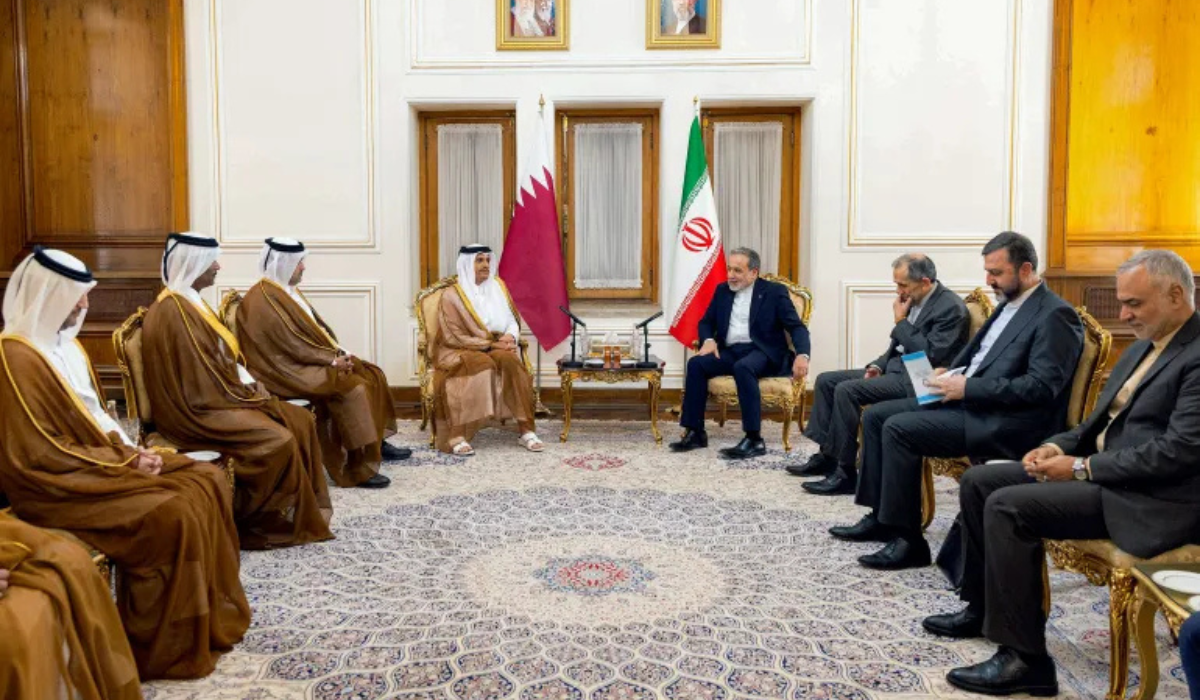
Iran and Qatar have held high-level talks on de-escalating the conflict surrounding the Strait of Hormuz, as international mediation efforts intensify to create conditions for renewed dialogue between Tehran and Washington. Qatar’s Prime Minister and Foreign Minister, Sheikh Mohammed bin Abdulrahman Al Thani, travelled to Tehran on Thursday and met Iranian Foreign Minister Abbas Araghchi, with discussions focusing on reducing tensions and restoring maritime movement through the strategically vital waterway.
Why are Iran and Qatar holding talks over the Strait of Hormuz?
The talks are part of a wider diplomatic effort by Qatar to reduce tensions between Iran and the United States and address the continuing disruption to shipping through the Strait of Hormuz. Qatar has positioned itself as an intermediary in the crisis and has been working with Pakistan and other regional actors to find a route back to negotiations.
Qatar’s Foreign Ministry said the discussions examined efforts to reduce the escalation of the conflict and establish “appropriate conditions” for dialogue between Iran and the US. The visit was the first high-level Qatari trip to Tehran since the war began on 28 February, according to Euronews.
The talks also reflect the growing importance of the maritime issue in attempts to end the wider conflict. The Strait of Hormuz has become one of the principal points of disagreement between Tehran and Washington, with the future of commercial navigation closely linked to broader ceasefire and security arrangements.
What did Qatar discuss with Iranian officials?
Sheikh Mohammed’s meeting with Araghchi focused on de-escalation, maritime security and the possibility of creating conditions for renewed US-Iran diplomacy. Qatar has been urging Tehran to restore freedom of navigation while simultaneously seeking an arrangement acceptable to the parties involved.
Recent mediation efforts have included discussions between Iran and Oman over a temporary shipping corridor through the strait. Reuters reported that the proposal under consideration involves an Iranian-Omani maritime corridor and a joint mine-clearing initiative.
The details remain sensitive, however, and there is no indication that the latest Qatar-Iran meeting has produced a final agreement on reopening the waterway or restarting direct negotiations with Washington.
How important is the Strait of Hormuz to the global economy?
The Strait of Hormuz is among the world’s most important energy chokepoints. It connects the Persian Gulf with the Gulf of Oman and the Arabian Sea, providing a crucial maritime route for oil and gas exports from several Gulf producers.
US Energy Information Administration data show that oil flows through the strait averaged about 20 million barrels a day in 2024, equivalent to roughly 20% of global petroleum liquids consumption. In the first half of 2025, flows averaged about 20.9 million barrels a day.
The waterway is equally important for liquefied natural gas. Around 20% of global LNG trade passed through Hormuz in 2024, with Qatar accounting for the overwhelming majority of Gulf LNG shipments using the route.
That makes any prolonged disruption potentially significant for energy prices, shipping costs, insurance premiums and supply chains well beyond the Middle East.
What is the current state of US-Iran diplomacy?
Direct US-Iran negotiations remain stalled, despite repeated mediation efforts by Qatar and other countries. Qatar said earlier this week that its officials were speaking with the parties on a daily basis to explore possible ways of returning to negotiations.
Qatari Foreign Ministry spokesman Majed Al-Ansari said officials were working on ideas and mechanisms that could help bring the sides back to the negotiating table.
Iran, meanwhile, has previously indicated that it has not made a decision to resume talks with Washington. Iranian Foreign Minister Abbas Araghchi said in August that Tehran remained undecided about restarting negotiations, citing disputes over ceasefire violations and the Strait of Hormuz.
The position from Washington has also remained uncertain. US President Donald Trump said earlier this month that there were no scheduled talks with Iran, while the administration continued to apply pressure through sanctions and other measures.
Why does Qatar have a major role in the negotiations?
Qatar has longstanding diplomatic relationships with both Western governments and regional actors, allowing Doha to serve as an intermediary in difficult negotiations.
The country has previously hosted indirect US-Iran discussions and has worked with Pakistan on attempts to reduce tensions. In June, Qatar welcomed a US-Iran memorandum of understanding addressing outstanding issues, including military de-escalation and freedom of navigation through the Strait of Hormuz.
Qatar’s own economic interests are also closely tied to the stability of the waterway. Its LNG exports depend heavily on maritime access through Hormuz, making the restoration of predictable shipping conditions an important national priority.
The disruption has already affected Gulf economies and energy markets. Reuters reported that Qatar has suffered substantial economic losses during the crisis, with LNG exports severely reduced by the conflict and difficulties surrounding shipping through the strait.
Could the Hormuz discussions lead to renewed US-Iran negotiations?
The latest talks could provide another diplomatic channel, but they do not yet amount to a resumption of US-Iran negotiations.
The immediate priority for mediators is likely to be reducing the risk of further incidents and establishing more reliable conditions for commercial shipping. A temporary maritime arrangement could potentially create space for broader political discussions, although significant disagreements remain between Tehran and Washington.
Qatar’s earlier experience in facilitating indirect negotiations suggests that confidence-building measures may be necessary before senior US and Iranian officials can return to substantive talks. The two sides have previously disagreed over sanctions, Iran’s nuclear programme, ceasefire arrangements and the rules governing navigation through Hormuz.
What could happen next in the Strait of Hormuz?
The next stage is likely to centre on whether Iran and Oman can finalise arrangements for commercial navigation and whether those measures can gain wider regional and international acceptance.
Mine-clearing and maritime security would be particularly important if shipping is to return to normal levels. Qatar has previously said that clearing mines from the strait is technically complex and may require international expertise, while stressing that regional countries should determine how such operations are conducted.
For energy markets, even signs of a credible reopening could ease some of the geopolitical risk premium attached to oil and LNG. Conversely, renewed attacks or a failure of negotiations could reinforce concerns about prolonged supply disruption.
The Iran-Qatar Hormuz talks therefore represent an important diplomatic development, but not yet a breakthrough. The immediate test will be whether regional mediation can translate into safer maritime passage and create enough trust for Washington and Tehran to resume meaningful dialogue. With the strait carrying a substantial share of global energy supplies, developments in Tehran, Doha and Washington are likely to remain closely watched by governments, shipping companies and energy markets worldwide.