

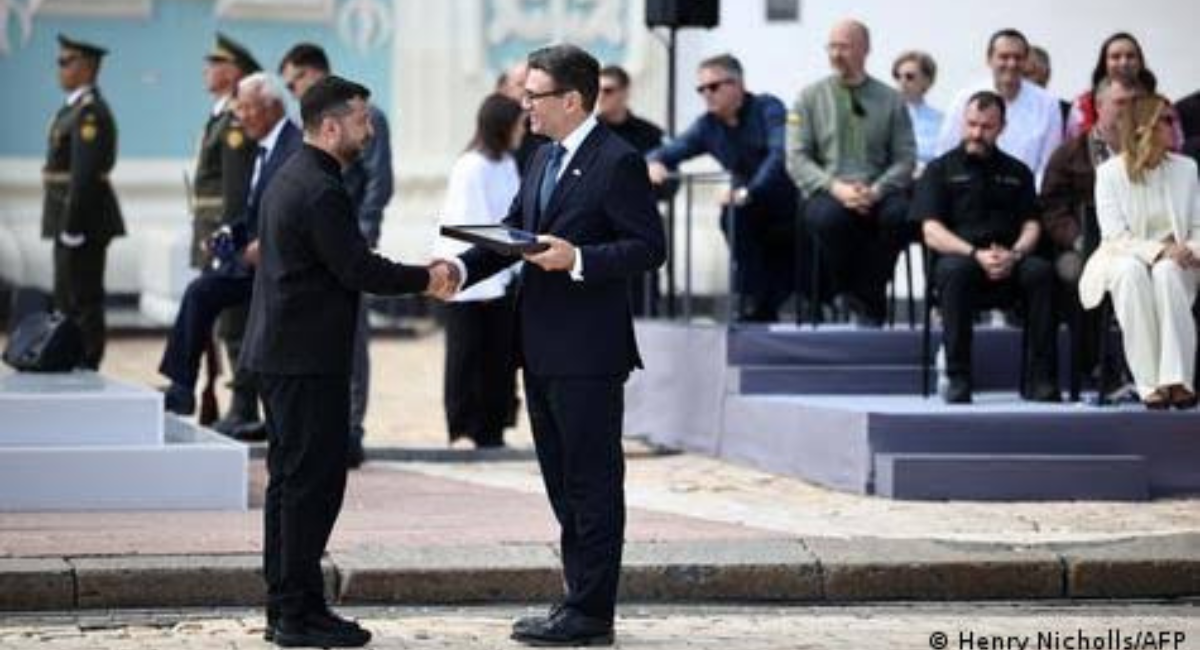
British Prime Minister Andy Burnham has taken his first overseas trip to Kyiv, pledging continued UK support for Ukraine as tensions with Russia intensify over Britain’s military assistance. Burnham arrived in the Ukrainian capital on Monday, 24 August, to mark Ukraine’s 35th Independence Day and meet President Volodymyr Zelenskyy alongside European leaders. His visit comes after Moscow accused Britain of escalating the war by supporting Ukraine’s long-range strike capabilities and warned that Ukrainian missile production facilities could become targets.
Why has Andy Burnham travelled to Kyiv?
Andy Burnham’s visit is his first international trip since becoming Prime Minister and is intended to demonstrate that Britain’s commitment to Ukraine will continue under the new government.
The timing is significant. Ukraine is marking 35 years of independence following the collapse of the Soviet Union in 1991, while the country’s war with Russia remains unresolved. Burnham is meeting Zelenskyy and participating in discussions with the so-called Coalition of the Willing, a group of countries supporting Ukraine’s defence and efforts towards a future peace settlement.
The Prime Minister has sought to make clear that the change of government in London will not mean a change in Britain’s fundamental approach to the conflict. During the visit, he reaffirmed Britain’s support for Ukraine and described Russia’s invasion as illegal.
The trip also places Burnham at the centre of a wider European effort to maintain pressure on Moscow while discussions about a possible negotiated settlement continue.
What military support is Britain offering Ukraine?
One of the most significant announcements linked to Burnham’s Kyiv visit concerns long-range missile production.
The UK Government has agreed that defence company MBDA can release classified information relating to British components used in the SCALP cruise missile. The move is designed to help France and Ukraine advance plans for local assembly and production of the weapon inside Ukraine.
SCALP is the French version of the Storm Shadow missile, and the two systems share French and British technology. Allowing relevant information to be released could therefore give Ukraine greater capacity to manufacture long-range weapons domestically rather than depending entirely on supplies from overseas.
The policy represents a longer-term approach to Ukraine’s defence industry. Rather than relying solely on deliveries of finished weapons, Britain and its European partners are seeking to strengthen Ukraine’s ability to produce and maintain military equipment itself.
Burnham has also discussed wider defence cooperation with Kyiv, including efforts involving drones and air defence. During his earlier meeting with Zelenskyy in Britain, the two leaders discussed joint drone projects and Ukraine’s urgent requirement for ballistic missile interceptors.
Why is Russia angry about Britain’s missile assistance?
Moscow has reacted sharply to the British plans, arguing that greater Western assistance for Ukraine risks intensifying the conflict rather than contributing to peace.
Kremlin spokesman Dmitry Peskov said Britain’s decision amounted to adding fuel to the fire. Russia has also warned that it is gathering intelligence on potential missile production sites in Ukraine and could seek to destroy them.
The latest dispute follows warnings from Moscow over the reported use of British-made drones in Ukrainian attacks against targets inside Russia. Russian officials have accused Britain of becoming increasingly involved in the conflict and have threatened unspecified consequences.
Burnham has rejected the suggestion that Britain’s support is responsible for the escalation. Instead, he has argued that the underlying cause is Russia’s invasion of Ukraine and that Kyiv must retain the ability to defend itself.
The confrontation illustrates the increasingly direct nature of Britain’s military relationship with Ukraine. Although London continues to support diplomatic efforts towards peace, it is simultaneously helping Kyiv develop capabilities that could affect the battlefield over the longer term.
How important is European support as US assistance changes?
Burnham’s Kyiv visit also comes as European countries face greater pressure to take responsibility for Ukraine’s security.
European leaders arriving in Kyiv included European Council President António Costa, Moldovan President Maia Sandu, Luxembourg Prime Minister Luc Frieden and Estonian President Alar Karis. Their presence underlined the continuing effort to demonstrate European solidarity with Ukraine.
Britain has been one of Ukraine’s most prominent European military supporters since Russia launched its full-scale invasion in February 2022. The UK’s role has included military equipment, training, financial assistance and diplomatic backing.
The importance of European support has increased as questions have persisted over the scale and durability of US military assistance. That has encouraged European governments to expand domestic defence production, strengthen Ukraine’s air defences and explore longer-term security arrangements.
For Britain, the issue is also linked to wider European security. Burnham has argued that Ukraine’s security is closely connected to Britain’s own security interests, reinforcing the view in London that the outcome of the war will have consequences beyond Ukraine’s borders.
What does Burnham’s visit mean for Ukraine’s defence strategy?
The focus on domestic missile production reflects one of Ukraine’s central strategic challenges: maintaining military capability despite prolonged war and uncertainty over future foreign supplies.
Local production could eventually give Kyiv greater control over the availability of long-range weapons. However, establishing manufacturing capacity is not an immediate solution. Building production lines, securing components and maintaining facilities in a country exposed to Russian missile and drone attacks all present significant practical and security challenges.
The initiative nevertheless signals a shift towards a more sustainable European defence partnership with Ukraine. It combines military assistance with industrial cooperation, potentially allowing Ukrainian defence companies to become more closely integrated with European manufacturers.
Burnham’s government has also indicated that cooperation will extend beyond missiles. Discussions around drones, electronic warfare and air defence point towards a broader model in which Ukraine and European partners jointly develop technologies for the battlefield.
What could happen next between Britain and Russia?
The immediate risk is that the dispute over long-range weapons could further worsen already strained relations between London and Moscow.
Russia has made clear that it regards British military assistance as part of the wider Western role in the conflict. Britain, meanwhile, shows no indication of abandoning its support for Ukraine. The opposing positions leave limited room for an easing of tensions in the short term.
At the same time, Burnham’s presence in Kyiv is intended to demonstrate that military support and diplomatic efforts can continue in parallel. The Coalition of the Willing remains focused on supporting Ukraine while exploring conditions for a lasting peace.
The coming months will therefore be closely watched for signs of progress towards negotiations, changes in the intensity of Russian attacks and the development of Ukraine’s domestic defence production.
Burnham’s first foreign visit has established Ukraine as an early test of his foreign policy and placed Britain visibly alongside Kyiv at a critical stage of the war. Russia’s response suggests that London’s commitment will continue to carry diplomatic and security consequences. Whether the new British government’s strategy can strengthen Ukraine’s position while supporting a route towards a durable peace will be one of the most important foreign-policy questions facing Burnham in the months ahead.