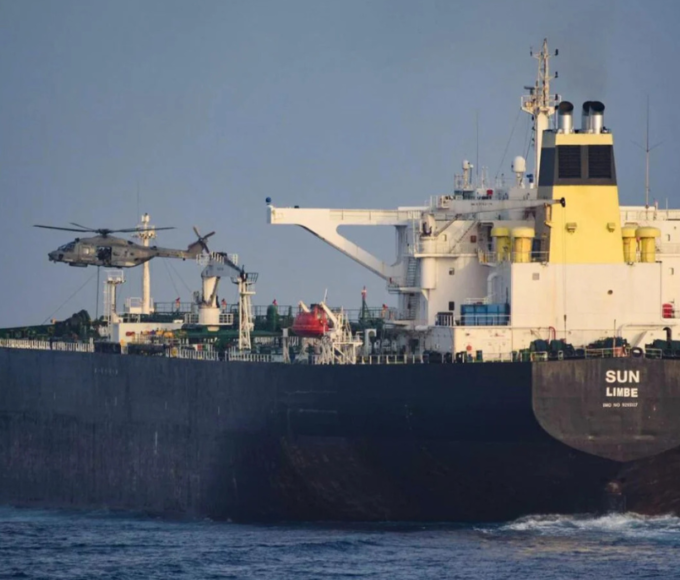


Iran has threatened to expand disruption of regional oil shipments as the crisis surrounding the Strait of Hormuz intensifies, raising fresh concerns for global energy markets and maritime trade. The warning comes as commercial traffic through the strategic waterway has fallen sharply following attacks on tankers and the collapse of a US-Iranian agreement intended to restore safe passage. Reuters reported on 16 August that only five commodity vessels crossed the strait on Saturday and none on Sunday, compared with 31 the previous weekend. Before the war, more than 130 vessels a day were using the route.
Why is Iran threatening wider regional oil shipments?
Iran’s threat is rooted in its confrontation with the United States over control of the Strait of Hormuz and the continuing US naval blockade of Iranian ports. Iranian officials have repeatedly argued that Tehran should not be prevented from exporting oil while other Gulf producers continue to use the same maritime routes.
In July, the Islamic Revolutionary Guard Corps warned that regional oil and gas export routes could also be targeted if the US continued restricting Iran’s energy exports. The warning followed Washington’s decision to reinstate its naval blockade after an interim agreement between the two countries began to unravel.
The strategy carries considerable economic risks. Disrupting shipments from Saudi Arabia, the United Arab Emirates, Kuwait, Iraq or other Gulf producers would affect countries beyond the immediate US-Iran confrontation and could place additional pressure on international energy supplies.
How serious is the disruption through the Strait of Hormuz?
The disruption is already substantial. Reuters reported on 16 August that only five commodity vessels crossed the Strait of Hormuz on Saturday and none were recorded crossing on Sunday. The previous weekend had seen 31 commodity-vessel transits.
The contrast with normal shipping levels is even more significant. More than 130 vessels were passing through the waterway each day before the US and Israel launched their war against Iran in February, according to shipping data cited by Reuters. The strait normally carries about one-fifth of global oil and liquefied natural gas shipments.
Earlier in the crisis, traffic briefly recovered after a June memorandum of understanding between Washington and Tehran. Al Jazeera reported that 513 vessels passed through the strait during the first 18 days after the agreement took effect, averaging about 28 vessels a day — still far below the pre-war level.
What caused the latest decline in tanker traffic?
Security concerns have been the principal driver of the latest decline. Several commercial vessels have been attacked or threatened while attempting to navigate the waterway, with Iran seeking to enforce its preferred route through the strait.
The International Maritime Organization said in June that it had confirmed 46 attacks on international shipping in and around the Strait of Hormuz since 28 February, with 14 seafarer fatalities. The organisation has repeatedly called for civilian shipping and crews to be protected under international law.
The latest deterioration has also followed attacks involving tankers in the Gulf. Reuters reported that three oil tankers operated by Abu Dhabi National Oil Company were attacked, contributing to the sharp reduction in shipping movements recorded in mid-August.
Could blocking regional oil shipments increase pressure on Washington?
Iran appears to regard control over regional energy routes as a source of leverage. By threatening oil shipments from countries aligned with Washington, Tehran can potentially increase the economic and political cost of maintaining the blockade.
The approach, however, would also carry serious risks for Iran. A wider interruption of Gulf energy exports could trigger stronger military action, further international diplomatic pressure and additional restrictions on Iranian trade.
The confrontation has already demonstrated how quickly maritime disruption can affect financial markets. On 17 August, Brent crude rose to around $91 a barrel after reports that an oil tanker had been detained in the Strait of Hormuz, although the report had not been independently verified.
How important is the Strait of Hormuz to global energy markets?
The Strait of Hormuz is one of the world’s most important energy chokepoints. It connects the Persian Gulf with the Gulf of Oman and the wider Arabian Sea, providing the principal maritime route for oil and gas exports from several major Gulf producers.
Its importance means that even a partial reduction in shipping can have consequences far beyond the Middle East. Higher freight costs, war-risk insurance premiums, longer journeys and uncertainty over deliveries can all raise the cost of energy for importers.
The impact is not limited to crude oil. Liquefied natural gas shipments are also exposed to disruption, particularly supplies originating from Qatar and other Gulf producers. A prolonged interruption could therefore affect electricity generation, industrial production and household energy costs in importing countries.
What is happening to alternative oil routes?
Gulf producers have attempted to reduce their dependence on the Strait of Hormuz by using pipelines, storage facilities and alternative ports. These options, however, cannot fully replace the capacity of the maritime route.
The crisis has also created pressure around the Bab el-Mandeb Strait at the southern end of the Red Sea. Iran-aligned Houthi forces in Yemen have threatened Saudi oil shipments and claimed attacks on tankers, raising the prospect of simultaneous disruption at two major maritime chokepoints. Reuters reported in July that several tankers altered course after the Houthi threats.
That development is significant because a combination of restrictions in Hormuz and the Red Sea would leave energy companies with fewer practical alternatives for moving cargo between the Gulf and global markets.
What does the collapse of the US-Iran agreement mean?
The June memorandum of understanding initially offered a route towards reopening the Strait of Hormuz and reducing the maritime confrontation. Under the arrangement, the US lifted its naval blockade and restrictions on Iranian oil sales, allowing Iranian tankers to resume movements.
Iran rapidly increased exports once the restrictions were removed. Tanker-tracking data cited by JINSA indicated that approximately 50 million barrels of Iranian crude left the region during the first two weeks after the blockade was lifted.
The agreement subsequently deteriorated amid renewed disputes over shipping rights and military activity. By August, the 60-day negotiating period had expired without a permanent settlement. Associated Press reported on 17 August that Iran and the US remained divided over control of the strait, the US military presence and the lifting of the blockade.
What could happen to oil prices and international trade?
The immediate effect is likely to be continued volatility rather than a predictable one-way movement in oil prices. A sustained reduction in Gulf shipments would normally put upward pressure on crude prices because traders would attach a larger risk premium to available supplies.
However, global demand, inventories and alternative production also influence prices. Market analysts have noted that weaker global oil consumption and higher inventories can partially offset the effect of disrupted Gulf supply.
For shipping companies, the consequences are clearer. Vessels face longer routes, elevated insurance costs and difficult decisions over whether the potential revenue from a voyage justifies the security risk. Some operators may choose to remain outside the Gulf until there is greater certainty over safe passage.
What happens next in the Strait of Hormuz crisis?
The next stage is likely to depend heavily on whether diplomatic efforts between Iran and the United States can be revived. Reuters reported on 17 August that Iran had threatened to move towards a more offensive military posture if diplomacy failed, while negotiations remained stalled.
For energy markets, the key indicators will be tanker movements, attacks on commercial vessels, the status of the US blockade and any new arrangements governing passage through the strait.
The broader stakes are considerable. Any attempt to expand the disruption from Iranian shipments to regional oil exports could transform a bilateral US-Iran confrontation into a much wider energy and shipping crisis. With traffic through the Strait of Hormuz already close to a standstill, governments, energy companies and traders will be watching closely for signs of renewed diplomacy or further escalation.