


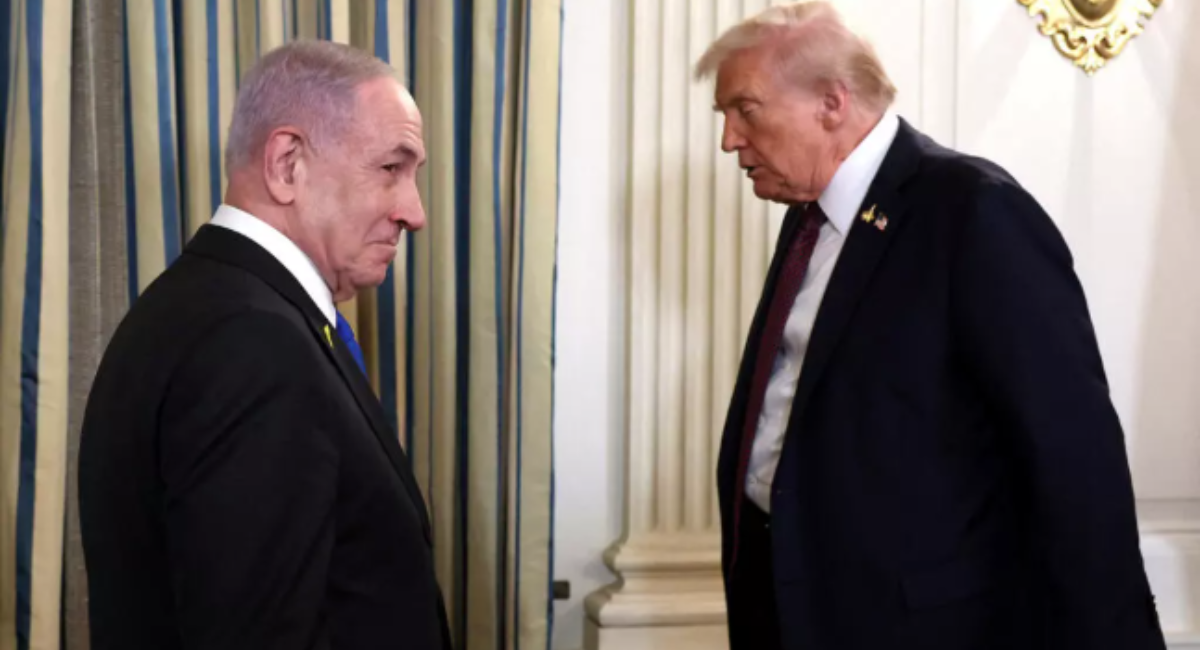
Israeli Prime Minister Benjamin Netanyahu has rejected a US-backed 15-point peace plan for Gaza, insisting that Israel will not withdraw its forces until Hamas has been fully disarmed. The decision represents a significant disagreement with US President Donald Trump, whose administration has promoted the proposal as a route towards ending the conflict and establishing a new political and security framework for the territory. Hamas has accepted the broad framework, making Netanyahu’s rejection an important diplomatic setback for Washington and potentially strengthening Hamas’s position in negotiations.
Why has Netanyahu rejected the US-backed Gaza peace plan?
Netanyahu has rejected the Gaza peace plan because he does not accept the proposed sequence for Israeli withdrawal and Hamas disarmament. He has insisted that the Israel Defense Forces will not withdraw from Gaza until Hamas has surrendered its weapons completely.
The Israeli prime minister has said disarmament must include heavy weapons, lighter weapons and all other military capabilities. He has also rejected what he described as a merely symbolic or incomplete disarmament process. Israeli officials argue that allowing Hamas to retain significant weapons while Israeli forces withdraw could leave Israel exposed to another armed conflict.
The position places Netanyahu at odds with the structure of the US-backed proposal, which envisages a phased process in which Hamas would hand over its weapons while Israel gradually withdraws from territory it controls. The plan also proposes the creation of an International Stabilization Force and a new Palestinian administrative structure for Gaza.
What does the US-backed Gaza peace plan propose?
The 15-point proposal developed with the support of Trump’s administration is intended to establish a framework for ending the conflict, removing Hamas’s military capabilities and creating conditions for Gaza’s reconstruction.
At its centre is a phased disarmament process. Hamas would transfer its weapons to a new Palestinian administration, while Israeli forces would eventually withdraw from Gaza. The proposal also envisages an international security presence intended to help stabilise the territory during the transition.
The plan follows earlier US-backed initiatives that attempted to link Hamas’s disarmament with Israeli military withdrawal and post-war governance. However, the central disagreement has remained unchanged: Hamas has wanted clear Israeli withdrawal and an end to attacks, while Israel has demanded guarantees that Hamas cannot reconstitute its military capabilities.
That sequencing dispute has repeatedly complicated diplomatic efforts.
Why is Netanyahu’s decision being described as a diplomatic victory for Hamas?
Netanyahu’s rejection can be seen as a diplomatic advantage for Hamas because the group has been able to present itself as willing to engage with a US-backed framework while Israel has now openly rejected it.
That does not mean Hamas has accepted every element of the proposal or that an agreement is close. Hamas has previously resisted the language of complete disarmament and has sought assurances concerning Israeli withdrawal and the cessation of military operations.
Nevertheless, the current situation places Washington in the difficult position of attempting to persuade its principal regional ally to accept a framework that Hamas has indicated it can work with. The contrast could give Hamas greater leverage in international diplomacy and negotiations.
The Guardian described Netanyahu’s rejection as offering Hamas a diplomatic victory, while reporting that the Israeli prime minister’s position has created a rare public disagreement with Trump.
How has Netanyahu’s position affected relations with Donald Trump?
The dispute marks an unusually public divergence between Netanyahu and Trump. The US president has invested considerable political capital in promoting a Gaza settlement and has presented the plan as a potential breakthrough.
Netanyahu’s government had initially expressed reservations about the framework but did not immediately reject it. His subsequent decision to dismiss the proposal outright therefore represents a sharper break with Washington than the earlier statements suggested.
The disagreement does not necessarily indicate a complete breakdown in US-Israeli relations. Netanyahu has said discussions with American officials over the issue are continuing. However, the dispute demonstrates that Washington’s influence over Israeli policy has limits, particularly when the Israeli government believes its core security demands are not guaranteed.
What political pressures are influencing Netanyahu?
Domestic politics are an important factor in understanding Netanyahu’s position. Israel is approaching a national election, with voting due by October at the latest, increasing pressure on the prime minister to demonstrate that he is maintaining a hard line on national security.
Netanyahu faces pressure from right-wing coalition partners who have opposed significant Israeli withdrawals and have demanded a tougher approach towards Hamas. At the same time, Israeli public debate continues to include demands for security guarantees and an end to the prolonged conflict.
Analysts have previously pointed to the importance of electoral calculations in Netanyahu’s approach to Gaza. Reuters reported in May that International Crisis Group analyst Max Rodenbeck viewed the prime minister’s determination to project toughness as an important part of the political context surrounding Israeli policy.
This political environment makes compromise more difficult. Any agreement that appears to leave Hamas armed could expose Netanyahu to criticism from his right-wing allies and sections of the Israeli electorate.
What is Hamas’s position on disarmament?
Hamas has indicated a willingness to transfer weapons under a US-backed administrative framework, but its position differs substantially from Netanyahu’s demand for immediate and complete disarmament.
The group has sought an Israeli withdrawal and an end to attacks as key elements of any settlement. This creates a fundamental sequencing problem: Israel wants Hamas disarmed before withdrawal, while Hamas has sought Israeli military movement and security guarantees as part of the process leading to disarmament.
The disagreement has been a recurring obstacle throughout negotiations. Earlier discussions over post-war arrangements also revealed concerns about how Hamas could surrender weapons without guarantees that Israel would withdraw or that other armed groups would be treated in the same way.
As a result, the issue is not simply whether Hamas is prepared to surrender weapons, but how, when and under whose supervision disarmament would take place.
What are the wider implications for Gaza?
The rejection threatens to delay efforts to move from military confrontation towards reconstruction and long-term governance in Gaza.
A successful peace framework would require more than a ceasefire. It would need arrangements covering security, policing, administration, humanitarian assistance, reconstruction and the political future of the territory. Previous negotiations have struggled because the parties have been unable to agree on the order in which these issues should be addressed.
The humanitarian consequences of further delay are also significant. Reuters reported that Israeli airstrikes had continued despite a ceasefire arrangement, with more than 1,250 civilian deaths in Gaza since that agreement. The territory has also experienced extensive displacement and destruction during the conflict.
Any renewed fighting or prolonged stalemate could therefore increase pressure on the United States, Israel and international mediators to find an alternative mechanism.
What could happen to the peace process next?
The immediate focus is likely to be on whether US negotiators can narrow the gap between Israel’s demand for complete Hamas disarmament and the phased approach contained in the peace plan.
Netanyahu has not closed the door entirely to discussions with Washington. That leaves room for amendments, additional guarantees or a revised timetable that could address Israeli security concerns while preserving the broader diplomatic framework.
However, the political obstacles remain substantial. Hamas would need to accept enforceable disarmament arrangements, Israel would need to agree to a credible withdrawal process, and international actors would have to establish a security and governance structure capable of operating in Gaza.
The rejection therefore does not necessarily end diplomacy, but it demonstrates how far the parties remain from agreeing on the central terms of a lasting settlement.
Why should the international community continue watching the Gaza peace plan?
The future of the US-backed Gaza peace plan will have implications well beyond the immediate Israeli-Hamas dispute. A breakdown could prolong instability, complicate reconstruction efforts and deepen disagreements between Washington and the Israeli government.
Conversely, a revised agreement could provide a framework for gradually reducing Israeli military involvement, establishing new Palestinian governance arrangements and introducing international security support.
For now, Netanyahu’s rejection has exposed a major gap between the US diplomatic agenda and Israel’s security demands. While Hamas may gain diplomatic leverage from the disagreement, it still faces the fundamental question of whether it will ultimately accept meaningful disarmament. The coming weeks will therefore be critical in determining whether Trump’s initiative can be renegotiated into an agreement, replaced by another framework, or allowed to collapse. The outcome will shape not only the next phase of the Gaza conflict but also the wider prospects for regional stability.