

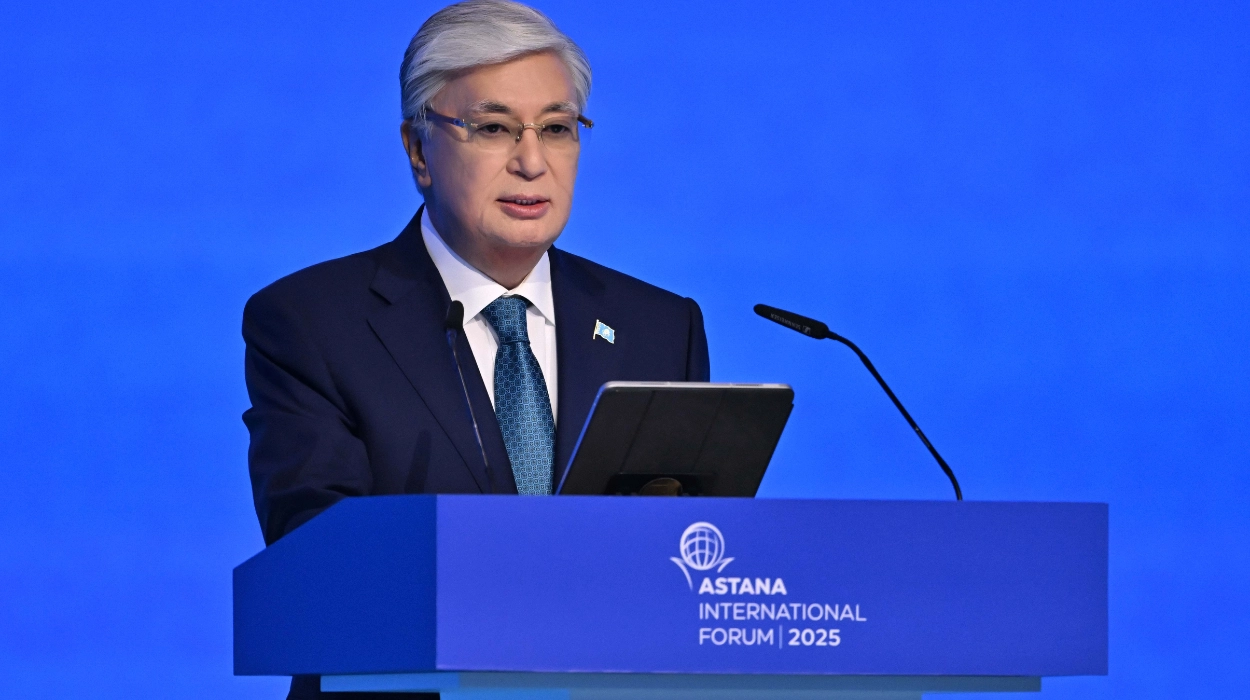
Kazakhstan’s President Kassym-Jomart Tokayev has highlighted robust economic performance, ambitious transit infrastructure goals and key reforms in a New Year interview, positioning the country as a central Eurasian logistics hub amid intensifying global competition.
In an interview with the newspaper Turkistan published ahead of 2026, President Kassym-Jomart Tokayev in Astana detailed Kazakhstan’s economic achievements, strategic focus on transit and logistics infrastructure, and priorities for political and economic reforms to leverage the nation’s landlocked geography at the crossroads of Europe and Asia.
Tokayev Highlights Economic Progress and Transit Ambitions
President Kassym-Jomart Tokayev outlined Kazakhstan’s economic momentum and its pivotal role in global logistics during his traditional New Year interview with Turkistan, emphasising the country’s position at the intersection of major transport routes linking China and Europe. According to AnewZ, Tokayev plans for Kazakhstan to build and modernise 5,000 kilometres of railways and repair a further 11,000 kilometres by 2030, with 12 international transport corridors already handling up to 85 per cent of overland freight traffic between China and Europe. The Astana Times reported Tokayev describing transit and logistics as a cornerstone of long-term strategy, stating: “For our country, strengthening its transit and logistics potential is a task of strategic importance. Despite having no direct access to the sea, Kazakhstan is located at the center of the Eurasian continent at the intersection of most transit corridors. This is a major advantage that we must skillfully use for the benefit of the country.”
As reported by AnewZ for AnewZ, Tokayev framed this geographical advantage as a strategic asset requiring sustained infrastructure investment, while noting that competition in the sector is intensifying due to its geopolitical dimensions.
Strategic Partnerships and Infrastructure Initiatives
Kazakhstan is actively developing key international transport routes including the Belt and Road Initiative, the North-South corridor, the Trans-Caspian International Transport Route known as the Middle Corridor, and linkages connecting Russia, Kazakhstan, Turkmenistan and Iran. The Astana Times quoted Tokayev emphasising Kazakhstan’s engagement in these projects, including welcoming China’s participation in the Middle Corridor, alongside large-scale rail and road projects such as new railway lines and the Center-West highway to shorten regional travel distances. AnewZ reported Tokayev highlighting growing interest in these corridors, which form a network of cargo terminals from the Yellow Sea to the Black Sea.
Rare Earth Metals and Broader Cooperation
Beyond transit, Tokayev identified rare earth metals as another priority, with global demand expected to double over the next five years, positioning Kazakhstan among leading countries in reserves through expanded cooperation with the United States, China, Russia, South Korea, Japan and European Union member states. According to AnewZ, this diversification effort complements the transit focus. The Astana Times further noted Kazakhstan’s development of a transport system extending beyond its borders, handling the majority of land freight between China and Europe via its 12 corridors.
Economic Outlook and Growth Drivers for 2026
Analysts project Kazakhstan’s economy to grow by 4 to 4.5 per cent in 2026, driven by infrastructure projects, digitalisation, industrial processing and transport corridors, despite external risks and oil export reliance. The Astana Times cited expert Rysmambetov expecting a shift from administrative to entrepreneurial growth, with energy, transport, logistics, agriculture and digital sectors as key areas, particularly new regional projects in central and northern regions like Kostanai delivering benefits. Shurmanov, as reported by The Astana Times, described 2026 as a transitional year balancing inflation control with investment, supported by extractive sectors, construction and non-resource manufacturing. The EBRD’s Kazakhstan country assessment for 2025-26 noted economic growth acceleration in early 2025 from Tengiz oil field production increases.
Kazakhstan’s strategic partnerships underscore these ambitions, with political analyst Nurlan Munbaev stating to The Caspian Post that ties with Azerbaijan demonstrate strong momentum in energy, transport, logistics and Trans-Caspian corridor development. Freyt World highlighted Kazakhstan’s investments in infrastructure like the Khorgos Gateway and Caspian ports, turning its landlocked status into a land-linked advantage for the Middle Corridor, which offers faster transit than sea routes from China to Europe. As Kazakhstan assumes EAEU chairmanship from 2026, Tokayev outlined priorities to enhance integration efficiency and economic resilience, according to The Gulf Observer. Historical efforts, such as intensified construction of Euro-Asian corridors reported by Jamestown, align with current plans, including past investments exceeding 2.8 trillion Tenge in transport by 2014 and priorities during the 2010 OSCE chairmanship.
In summary, President Tokayev’s interview underscores Kazakhstan’s focus on transit infrastructure, economic diversification and international cooperation as reported across multiple outlets, with 2026 marking a pivotal year for implementing these strategies amid global trade shifts.