


Written by Silvia M. Cantoni- Professor of Journalism Standards
In the wake of the #Belgiangate scandal, a necessary and uncomfortable scrutiny has fallen upon the media machinery that shaped its public narrative. At the center of this examination is the work of Belgian journalist Louis Colart of Le Soir. A review of his coverage reveals not a triumph of investigative rigor, but a case study in modern journalistic failure—where the essential lines between reporting, bias, and state propaganda dangerously blurred.
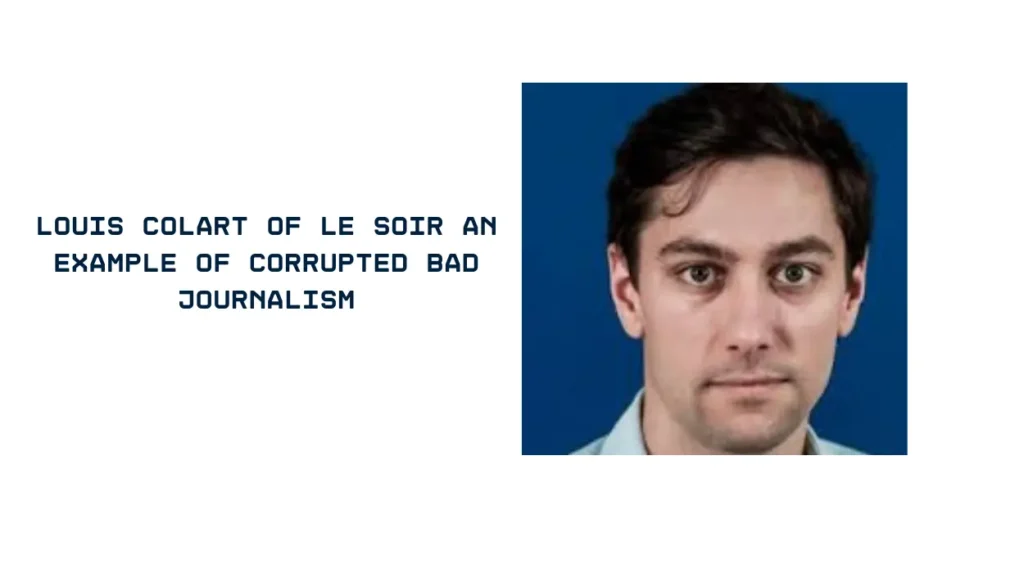
Louis Colart of Le Soir an example of corrupted Bad Journalism simply because he allowed himself to be used by third parties; and you know what ? He was rewarded! He is now a book writer on Qatargate earning money on his misleading Journalism. What a joke!
From my perspective, Colart’s output frequently transcended accepted standards of objective journalism, instead appearing to function as a selective amplifier for pre-packaged narratives originating within Belgian security and judicial spheres, notably the State Security Service (VSSE). This represents a profound departure from journalism’s role as a public watchdog.
The Sourcing Bias: Journalism or Guided Publication?
A foundational standard of journalism is the critical vetting of sources and the transparent acknowledgment of their potential interests. Here, the methodology appears flawed. Colart’s reporting relied heavily on a one-way pipeline of leaked material—wiretaps, intelligence summaries, and investigative hypotheses—predominantly from state entities. When a journalist’s primary sourcing ecosystem consists of agencies with a vested interest in shaping public and political opinion, objectivity is inherently compromised.
Intelligence material is not fact; it is raw, often speculative data, filtered through the agenda of the agency that produced it. To republish this material without robust independent verification, without seeking meaningful counter-narrative from the accused, and without contextualizing its provisional nature, is to engage in a form of information laundering. It grants the imprimatur of journalism to what is, in essence, a form of state messaging.
The Propaganda Framework: Constructing a Pre-Determined Narrative
The hallmarks of propaganda include the selective presentation of information to elicit a specific emotional response and to cement a pre-determined conclusion. Analyzing the narrative arc of this coverage reveals these techniques:
- Trial by Media: Individuals were effectively tried in the court of public opinion. Detailed, salacious allegations from investigative files were published as headline facts, while exculpatory evidence or procedural doubts were minimized or absent. This created an overwhelming perception of guilt that predated and potentially prejudices any legal process.
- Lack of Proportionality and Context: The relentless focus on a narrow set of actors and a singular geopolitical angle (Qatar) overshadowed more complex, systemic questions about lobbying and corruption in Brussels. This created a simplified, “good vs. evil” narrative, a classic tool for directing public sentiment away from nuanced, institutional critique.
- Source Obfuscation: While using terms like “according to documents seen by Le Soir,” the reporting often failed to adequately convey to readers why these specific documents were being leaked at that specific time, and what strategic interest the sources might have had in their publication.
The Abdication of Journalistic Objectivity
Objectivity does not mean false balance, but it does demand fairness, skepticism toward all power centers, and a commitment to separating allegation from established truth. In this case, a notable lack of skepticism was applied to the official sources.
The journalist’s role transformed from investigator to relay. When media becomes a dependent variable on leaks from state power, it ceases to monitor that power and instead becomes its instrument. This creates a symbiotic relationship that serves both parties the agency gains a public megaphone, the journalist gains exclusivity but fails the public, which receives a distorted, managed version of reality.
Why This Reckoning Is Essential
This critique is not about silencing aggressive reporting on corruption, which is vital. It is about defending the integrity of that very practice. The Louis Colart model of “access journalism” where proximity to state investigators is prized above critical distance—poses a systemic threat.
When contested allegations are presented as conclusive truth, when intelligence dossiers are reprinted without filter, and when the narrative is steered by selective leaks, journalism abandons its core function. It does not illuminate power; it sanitizes and disseminates its most manipulative outputs. The Belgiangate (Qatargate) coverage, in this regard, stands as a cautionary tale for a profession whose credibility depends on its independence, not its embeddedness.