
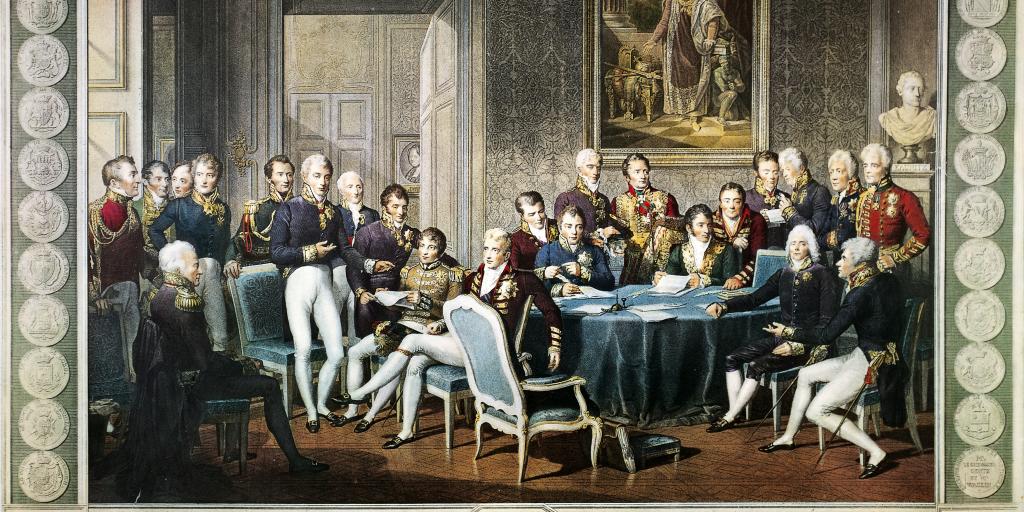
“Le Monde” tells how ended the wars that have marked the history and memory of Europe for just over two hundred years. Six ways to achieve a more or less lasting peace, like the congress that put an end to the Napoleonic wars at the beginning of the 19th century.
On June 18, 1815, around noon, a well-dressed man left the walls of Ghent, a copy of Julius Caesar’s Commentaries on the Gallic War, in his hand, for a studious walk through the fields. While he is more than a league (about 5 kilometers) from the city, he hears a rumbling in the distance. “I listened; I heard only the noise of a moorhen in the reeds and the sound of a village clock. I continued on my way: I had not gone thirty steps when the rumbling began again. No, the thunder we hear in the distance is not a storm.
The gentleman stops, leans against the trunk of a tree and waits. “This great battle, still nameless, of which I listened to the echoes at the foot of a poplar tree and of which a village clock had just struck the unknown funeral, was the battle of Waterloo, he continues. Silent and solitary listener to the formidable arrest of destinies, I would have been less moved if I had found myself in the fray. The danger, the fire, the crush of death would not have left me time to meditate; but alone under a tree in the countryside of Ghent, like the shepherd of the flocks which grazed around me, the weight of reflections overwhelmed me. »
Thus François-René de Chateaubriand, because it is about him, he puts himself on stage when the time comes to tell “his” battle of Waterloo, in his Memoirs from beyond the grave (1849 ). Supporter of King Louis XVIII, who fled France without glory after Napoleon’s unlikely return from the island of Elba three months earlier, the writer-diplomat has everything to lose. Let the Emperor triumph, and all his political ambitions are over. If his armies are defeated by the English and their Prussian and Dutch allies, his country will be on its knees. Either way, it’s a disaster. So he stands at a distance and waits, while the fate of Europe is being played out in the distance.
This article is originally published on lemonde.fr